
Safety considerations
Important safety information about osimertinib
This website is only intended for UK patients who have been prescribed TAGRISSO® (osimertinib)
Safety considerations
Important safety information about osimertinib
Before taking osimertinib tell your doctor about all your medical conditions and the medicines you take, including prescription and over-the-counter medicines, vitamins, or herbal supplements.1
Looking after your skin while taking osimertinib

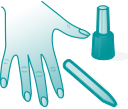
Ask for advice from your cancer care team before having manicures, pedicures or chiropody.2,3

Wear gloves while washing up.2,4

It’s ok to cover up a rash with make-up; try using hypoallergenic (skin friendly) foundation and remove it with hypoallergenic liquid cleanser. If in doubt, ask your cancer care team for advice before using make-up to cover up a rash.2

Consider using non-biological washing powder.2,5

Moisturise your skin regularly – at least twice a day. Your cancer care team will advise which creams are best for you.2,4

Avoid highly perfumed products.2,5

Avoid over-the-counter acne treatment.2
Shower with lukewarm water; avoid long, hot showers.2,5

Pat yourself dry with a towel (rather than using a more abrasive rubbing action).2,5

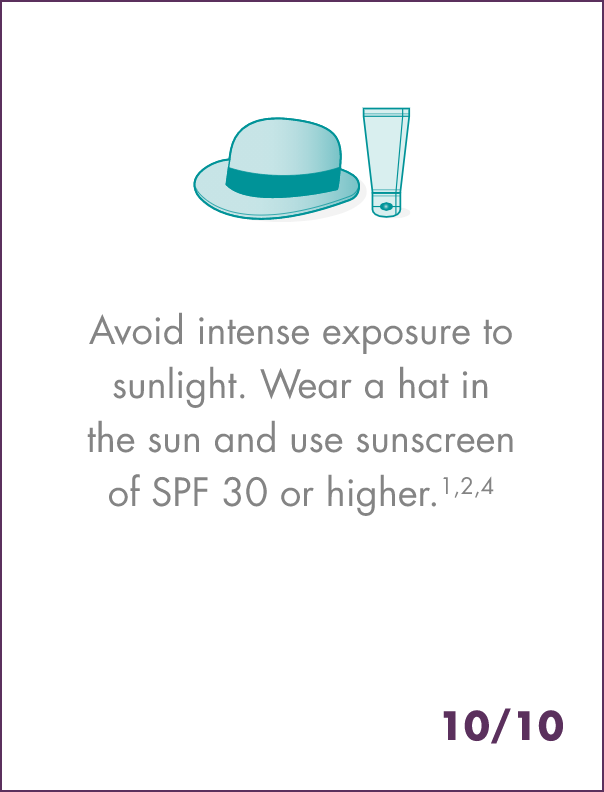
Avoid intense exposure to sunlight. Wear a hat in the sun and use sunscreen of SPF 30 or higher.1,2,4
- Mild: Slight rash on the chest or upper body, but no sign of infection and symptoms do not interfere with daily life.6

- Moderate: A more noticeable rash with symptoms such as acne-like spots, dryness and itching. However, the rash is still tolerable, and symptoms do not cause much interference with daily life.6

- Severe: More severe rash with an increased number of acne-like spots. Bothersome symptoms cause a high level of discomfort and an inability to continue with daily activities.6

Call your cancer care team as soon as you see any signs of a skin reaction. It may not be serious, but it’s still worth letting them know.1,2,6
The illustration and descriptions above will give you an idea of how to judge any skin reaction you may experience on osimertinib, and help you to describe your rash to your cancer care team
Mild cases of a pain, itching, dry skin, rash, redness around the fingernails. This is more likely in areas exposed to the sun. Using moisturisers regularly on your skin and nails can help with this.1,4,6 The illustrations on this page are provided as an example only. Skin reactions can appear on other parts of the body too.
Tell your healthcare professional straight away if you develop symptoms of Stevens-Johnson syndrome or toxic epidermal necrolysis, which can appear as reddish target-like macules or circular patches often with central blisters on the trunk, skin peeling, ulcers of mouth, throat, nose, genitals and eyes and be preceded by fever and flu-like symptoms.
IF IN DOUBT, SPEAK TO YOUR CANCER CARE TEAM
It’s important to drink plenty of fluids if you have diarrhoea to make sure you are hydrated.
Plain food and low-fibre diets can help with diarrhoea but tell your healthcare professional if it's severe or does not go away. Diarrhoea can be controlled with anti-diarrhoea medicine usually.1,4,7
Diarrhoea may come and go during treatment. Tell your doctor if your diarrhoea does not go away or becomes severe.1

In cases where your diarrhoea is severe – needing the toilet more than 4 times per day – or if it continues for a couple of days while you are taking anti-diarrhoea medicine, you must let your cancer care team know.1,4
If you are experiencing mouth sores, there are things you can do to help manage the symptoms:
Good oral health
Use a soft toothbrush to gently brush your teeth. Avoid mouthwashes with alcohol. Contact your cancer care team, who will be able to advise you on medicines for pain relief.4
Soothe the soreness
Use petroleum jelly lip balm to manage dry lips and SPF lip balm when going out in the sun.4,7
Mouth-friendly diet
Try to eat soft, soothing and moist foods like scrambled eggs rather than coarse food like toast. Use straws to drink liquids. Avoid acidic juices and spicy foods like curry.4,7
Mouth sores are caused by a condition called stomatitis, which is inflammation of the inner lining of the mouth or ulcers forming in the mouth. It can affect more than 1 in 10 people taking osimertinib. Your cancer care team may also prescribe soothing mouth rinses, lozenges or gels to help manage this side effect.1,4
IF IN DOUBT, SPEAK TO YOUR CANCER CARE TEAM
This is a common side effect that may affect about 1 in 10 people taking osimertinib.1
Tell your doctor straight away while taking this medicine if you have sudden difficulty in breathing together with a cough or fever.1 This may be a sign of inflamed lungs(a condition called ‘interstitial lung disease’). Most cases can be treated but some cases have been fatal.1
If you have a pre-existing heart condition, or if you are unsure if you have a heart condition, then talk to your cancer care team and they will be able to help.

Osimertinib may uncommonly cause changes in the electrical activity in the heart (QTc prolongation). It could also cause a condition in which the heart does not pump enough blood out of the heart in one beat as well as it should which could result in shortness of breath, tiredness and ankle swelling (suggestive of heart failure or left ventricular ejection fraction decreased).1
Let your cancer care team know right away if you feel dizzy or have discomfort in your chest or feel as though your heart beat is faster or irregular compared to normal.1
Rarely, osimertinib may be associated with a blood disorder called aplastic anaemia in which bone marrow stops producing new blood cells.1 This can lead to symptoms such as persistent fever, bruising or bleeding more easily, increased tiredness and a decrease in your ability to fight infection. Signs suggestive of this blood disorder may include persistent fever, bruising or bleeding more easily, increased tiredness and a decrease in your ability to fight infection. This side effect is rare: it may affect up to 1 in 1000 people.1
You must use effective contraception suited to you during treatment. Discuss with your cancer care team the most appropriate methods of contraception.1,8
Refer to the patient information leaflet in your box of tablets for more information.
You must not take osimertinib if you are pregnant. This is because it may harm the baby. If you are planning to become pregnant or if you become pregnant during treatment, tell your cancer care team straight away.1,8
If your partner becomes pregnant while you are taking osimertinib, tell your cancer care team straight away.1
Osimertinib may pass into semen. Therefore, it is important that men also use effective contraception. You must also do this after completing treatment:1,8
- Women – keep using contraception for at least 2 months after.
- Men – keep using contraception for at least 4 months after.
- Do not breast-feed while taking Osimertinib. This is because it is not known if there is a risk to baby.
If you have ever had or might now have a hepatitis B infection, please tell your doctor or healthcare professional. This is because osimertinib could cause hepatitis B virus to become active again. Tell your doctor or nurse if you get worsening tiredness or yellowing of your skin or white part of your eyes. You will be monitored more closely and specifically to check this and treatment may, if necessary, be stopped.1
Potential
side effects
Like all medicines, you may experience side effects on osimertinib
References:
- Tagrisso 40 mg and 80 mg film coated tablets. Patient Information Leaflet.
- Macmillan Cancer Support. Skin and nail changes from cancer treatment. Last Reviewed: 30 Sep 2019. Available at: https://www.macmillan.org.uk/cancer-information-and-support/impacts-of-cancer/changes-to-your-appearance-and-body-image/skin-and-nail-changes-from-cancer-treatment Accessed December 2023.
- Macmillan Cancer Support. Practical tips for caring for someone with cancer. Last Reviewed: 31 May 2019. Available at: https://www.macmillan.org.uk/cancer-information-and-support/supporting-someone/practical-support-when-you-look-after-someone/practical-tips-for-caring-for-someone-with-cancer Accessed December 2023.
- Califano R, Tariq N, Compton S,et al. Drugs. 2015;75(12):1335-48.
- NIH, National Cancer Institute. Chemotherapy and You. Last reviewed: Sep 2018. Available at: https://www.cancer.gov/publications/patient-education/chemotherapy-and-you.pdf Accessed December 2023.
- Melosky B. Curr Oncol. 2012;19(Suppl 1):S59-63.
- Macmillan Cancer Support. Eating problems. Last reviewed 01 Aug 2020. Available at: https://www.macmillan.org.uk/cancer-information-and-support/impacts-of-cancer/eating-problems Accessed December 2023.
- Tagrisso 40 mg and 80 mg film coated tablets. Summary of product characteristics.
GB-73014 I DOP: January 2026
This website is only intended for UK patients who have been prescribed TAGRISSO® (osimertinib), which is indicated after surgery in adults with stage 1B-3A NSCLC with a particular EGFR mutation, and also in locally advanced or metastatic NSCLC with a particular EGFR mutation. It does not replace the Patient Information Leaflet, which you can find in the carton containing your medicine and which you should read alongside this information. If you have any questions about your treatment, talk to your healthcare team or refer to the Patient Information Leaflet.